
Matteo Montani (b. 1972, Rome) is an Italian contemporary painter and sculptor whose practice explores the relationship between landscape, perception, and the human condition. He studied classical subjects in Rome before attending the Academies of Fine Arts in Urbino and Rome, graduating in 1997 with a thesis on the expressive function of the colour blue. Between 1988 and 1996, he worked as an assistant in Alfredo Pirri’s studio and, during his studies, contributed to exhibitions involving artists including Günther Förg and Michelangelo Pistoletto.
Montani is particularly known for his oil paintings on sandpaper, which evoke rarefied and precarious mental landscapes suspended between meditative intimacy and apparition. His work approaches landscape not simply as a visible subject, but as a space in which perception and revelation intersect with the human condition, creating an ongoing dialogue between vision, memory, and experience.
After his first gallery exhibition at Studio Casoli in Milan in 2000, Montani received the XL Premio Suzzara and, in 2001, was selected for the Biennale of Young Artists from Europe and the Mediterranean in Sarajevo. From 2005 to 2017, he maintained a continuous and privileged collaboration with Fabio Sargentini’s historic gallery L’Attico in Rome. He has also exhibited with galleries including Marilena Bonomo in Bari, Sergio Casoli and Luca Tommasi Arte Contemporanea in Milan, Valentina Bonomo in Rome, Otto Gallery in Bologna, Kalfayan Gallery in Athens, and Nicola Pedana in Caserta.
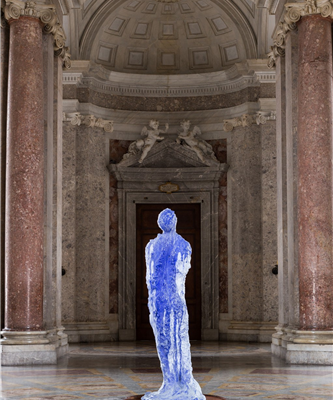
His institutional exhibition history includes participation in the Rome Quadriennale in 2008 and his first museum solo exhibition at MAR – Museo d’Arte della Città di Ravenna. In 2011, he presented his first solo exhibition abroad at Museum am Dom in Würzburg, Germany, where one of his large-scale works is displayed in the cathedral. He exhibited in New York at Casa Italiana Zerilli-Marimò in 2010 and at Elkon Gallery in 2016. In 2015, following his solo exhibition Andarsene at the Museo Andersen in Rome, the National Gallery of Modern and Contemporary Art (GNAM) in Rome acquired one of his experimental works, a sculpture that transforms through melting into a two-dimensional image.
More recent solo exhibitions include Natura Naturans at Luca Tommasi Arte Contemporanea in 2020, Nei colori del giorno at Museo Manzù in 2022, and The Days of Heaven at Luisa Catucci Gallery in 2023. Montani’s works are held in collections including the Vatican Museums, the Unicredit Collection, the VAF Collection, the ArteFiera Collection in Bologna, and significant private collections in Europe and the United States.
Matteo Montani (b. 1972, Rome) is an Italian contemporary painter and sculptor whose practice explores the relationship between landscape, perception, and the human condition. He studied classical subjects in Rome before attending the Academies of Fine Arts in Urbino and Rome, graduating in 1997 with a thesis on the expressive function of the colour blue. Between 1988 and 1996, he worked as an assistant in Alfredo Pirri’s studio and, during his studies, contributed to exhibitions involving artists including Günther Förg and Michelangelo Pistoletto.
Montani is particularly known for his oil paintings on sandpaper, which evoke rarefied and precarious mental landscapes suspended between meditative intimacy and apparition. His work approaches landscape not simply as a visible subject, but as a space in which perception and revelation intersect with the human condition, creating an ongoing dialogue between vision, memory, and experience.
After his first gallery exhibition at Studio Casoli in Milan in 2000, Montani received the XL Premio Suzzara and, in 2001, was selected for the Biennale of Young Artists from Europe and the Mediterranean in Sarajevo. From 2005 to 2017, he maintained a continuous and privileged collaboration with Fabio Sargentini’s historic gallery L’Attico in Rome. He has also exhibited with galleries including Marilena Bonomo in Bari, Sergio Casoli and Luca Tommasi Arte Contemporanea in Milan, Valentina Bonomo in Rome, Otto Gallery in Bologna, Kalfayan Gallery in Athens, and Nicola Pedana in Caserta.
His institutional exhibition history includes participation in the Rome Quadriennale in 2008 and his first museum solo exhibition at MAR – Museo d’Arte della Città di Ravenna. In 2011, he presented his first solo exhibition abroad at Museum am Dom in Würzburg, Germany, where one of his large-scale works is displayed in the cathedral. He exhibited in New York at Casa Italiana Zerilli-Marimò in 2010 and at Elkon Gallery in 2016. In 2015, following his solo exhibition Andarsene at the Museo Andersen in Rome, the National Gallery of Modern and Contemporary Art (GNAM) in Rome acquired one of his experimental works, a sculpture that transforms through melting into a two-dimensional image.
More recent solo exhibitions include Natura Naturans at Luca Tommasi Arte Contemporanea in 2020, Nei colori del giorno at Museo Manzù in 2022, and The Days of Heaven at Luisa Catucci Gallery in 2023. Montani’s works are held in collections including the Vatican Museums, the Unicredit Collection, the VAF Collection, the ArteFiera Collection in Bologna, and significant private collections in Europe and the United States.
“I consider my painting strictly connected with the history of the eye and the vision, where the eye becomes a sensitive membrane, a filter. I associate the pictorial space with a threshold, with a subtle screen suspended between two dimensions as a frontier, a passage. What I paint is something possibly situated between the eye and the soul, an unknown place that we could define the rift between the physical world and the spiritual, in its dissolving”. – Matteo Montani
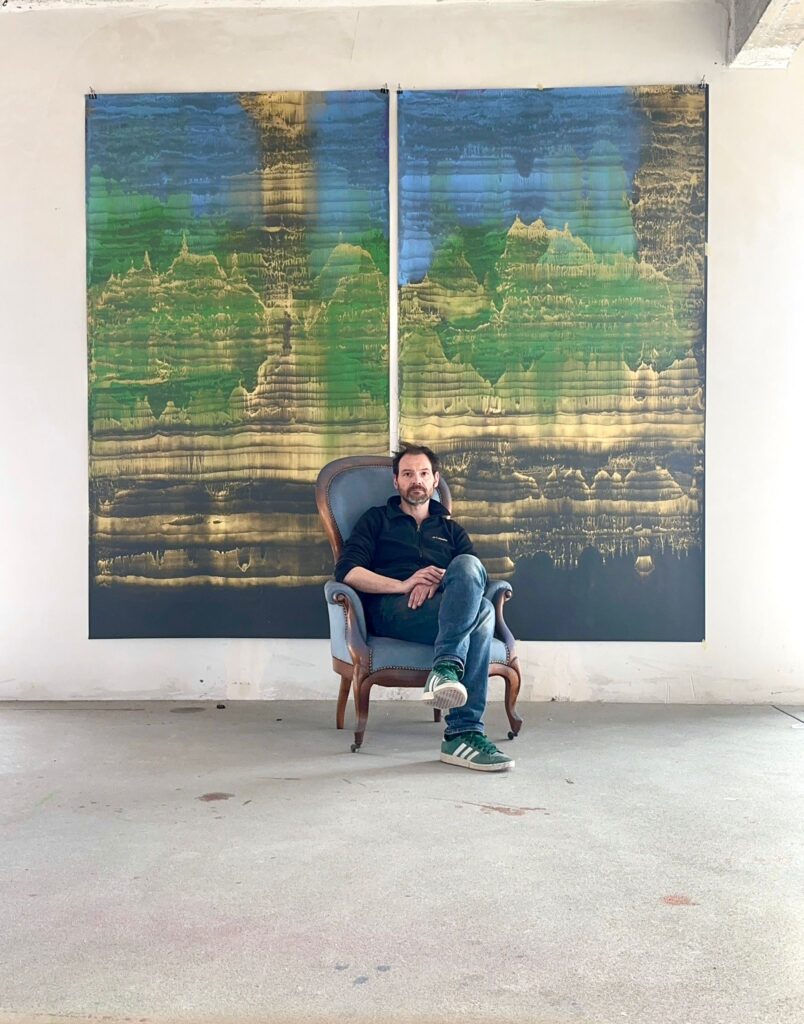
Montani’s evocative paintings conceive landscape not as the representation of a recognizable place, but as an emotional and perceptual experience. Drawing on the haunting atmospheres historically associated with Romantic skies and seas, he brings their expressive potential into a contemporary context by stripping them of any stable reference to the earthly world. His paintings occupy a space between figuration and abstraction, where the conventions of landscape remain perceptually present while their descriptive function gradually dissolves. The viewer recognizes the format as a landscape almost instinctively, yet is confronted with an enigmatic expanse in which literal geography gives way to colour, movement, atmosphere, and sensation.
In this sense, the designation of Montani’s works as landscapes is fundamentally cultural. What appears to be sky, sea, horizon, mist, or cloud is never offered as a fixed image of nature. Instead, these elements become vehicles through which the artist explores the intangible, the inexplicable, and the transcendent. The paintings establish a threshold between the visible and the imagined, inviting the viewer to move beyond the question of what is depicted and toward an experience of how the image is perceived. Colour and texture therefore acquire a structural rather than merely descriptive role: they become the means through which depth, movement, tension, and emotional resonance are constructed.
Montani’s chromatic language is carefully orchestrated. Transitions between darkness and light, warm and cool tones, density and transparency generate a persistent sense of movement and spatial instability. Colour appears to expand, recede, accumulate, or dissolve, producing an atmosphere that is simultaneously physical and psychological. The paintings seem to register states of transition rather than fixed conditions, evoking particularly the changing light of dawn and dusk—moments in which the world appears to exist between one state and another. This interest in transformation corresponds to Montani’s broader engagement with the perpetual becoming of things: nature is understood not as a static subject, but as an active process.
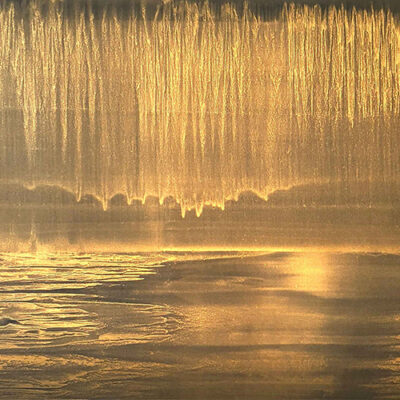
This principle is embedded in the artist’s working method. Montani’s practice has developed through an unusual combination of material experimentation, bodily gesture, and an acute awareness of the physical and chemical behaviour of his materials. His use of sandpaper, metal powders, oil, and turpentine turns the surface into an active field rather than a passive support. The resulting image is not simply applied to the surface; it emerges through a process in which the artist’s movements interact with the reactions and properties of the materials themselves.
The studio consequently becomes an expanded field of action. Montani works across the available surface, allowing his body to move freely around the work and incorporating even subtle variations produced through gesture, pressure, gravity, fluidity, and movement. The composition is therefore discovered through action rather than entirely predetermined. Scientific knowledge gives the artist an understanding of how materials may behave, but this knowledge does not eliminate unpredictability. On the contrary, it creates the conditions for a controlled encounter with chance.
It is within this tension between intention and autonomy that the idea of natura naturans becomes particularly relevant. Nature is not represented as an external image but activated within the process of making: “nature does what nature does.” The artist becomes one force among others, working in conjunction with the physical properties of the materials, gravity, movement, evaporation, fluidity, and even chaos. The painting consequently develops through a negotiation between artistic agency and material agency, binding the work to processes that exceed the artist’s complete control.
The specific behaviour of the materials is fundamental to the atmospheric character of the paintings. Oil and turpentine transform the sandpaper into a receptive yet resistant surface, allowing translucent and evanescent forms to emerge like clouds, vapours, or dissolving atmospheric phenomena. These effects can suggest cosmological spaces, but they remain materially grounded in the physical processes of painting. Metal powders introduce a contrasting weight and density. Against the ethereal movement of oils and solvents, they function as visual and material counterpoints, grounding the composition and returning its apparently immaterial atmosphere to the physical world.
Movement is consequently one of the fundamental principles of Montani’s painting. His works contain upward gestures reminiscent of vapour or mist, downward trajectories suggestive of rain or precipitation, and lateral movements that recall wind. These directions are not literal illustrations of natural phenomena; rather, they translate the forces associated with them into the language of painting. Colour intensifies these movements, transforming atmospheric suggestion into a dynamic structure that the viewer experiences almost physically.
More recently, Montani has extended this investigation by working directly on canvas, exploring the possibilities and resistance of a different surface. Rather than abandoning the principles developed through his work on sandpaper, he continues to investigate how movement can be generated through material intervention, including the use of air and other forces that allow the surface to participate in the formation of the image. The support becomes an active component of the work, contributing to its final appearance rather than simply receiving it.
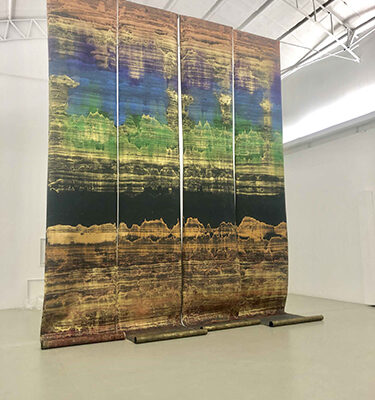
The large scale of many of Montani’s paintings is essential to this experience. The viewer is not positioned simply in front of an image but confronted by an environment of colour, matter, and movement. The works operate as perceptual fields into which the viewer is drawn. Their ambiguity prevents a stable reading and instead produces a sustained encounter with sensation, memory, and the limits of representation.
Montani’s paintings ultimately occupy a threshold between the physical and the spiritual, the material and the immaterial, control and chance. Their landscapes are not places to be identified but states to be entered. What begins as an apparently familiar horizon gradually becomes an indeterminate space in which the distinction between external nature and internal experience becomes increasingly unstable. In this sense, the paintings enact the artist’s conception of pictorial space as a frontier: a subtle screen suspended between dimensions, where the visible world begins to dissolve and perception becomes an experience situated somewhere between the eye and the soul.
ARTWORKS HIGHLIGHTS
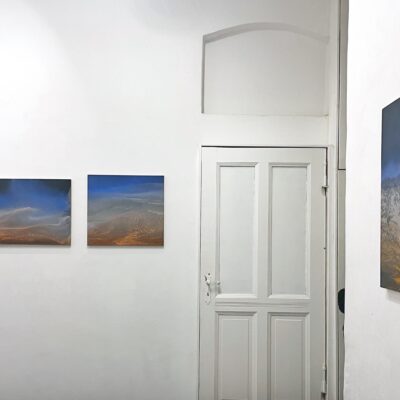
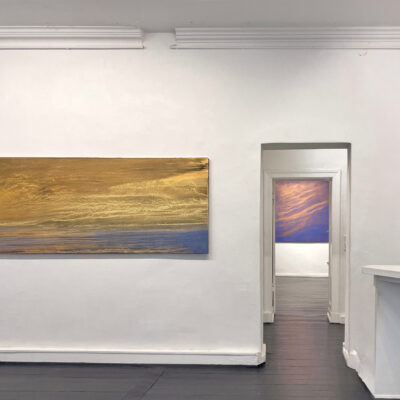
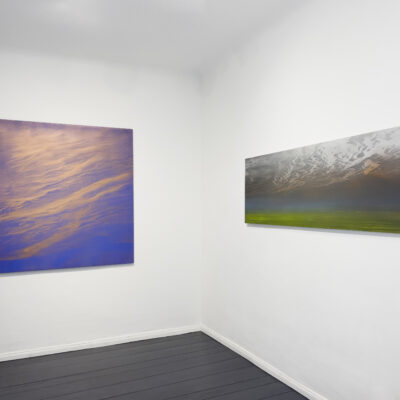
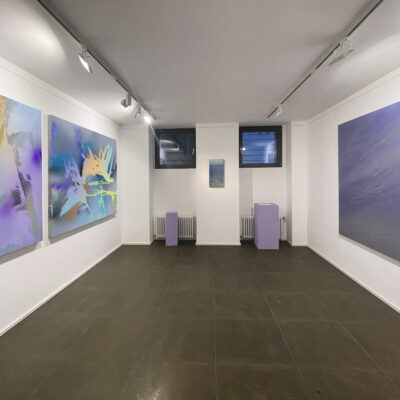
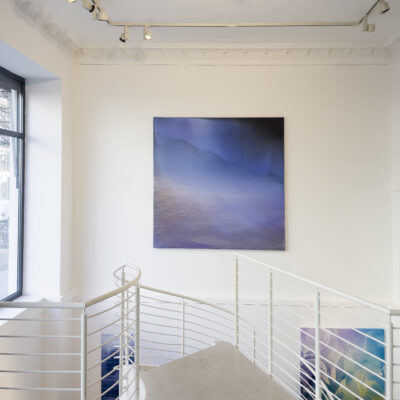
IINSTALLATION VIEWS
Exhibition Title: The Days of Heaven
Artists: Matteo Montani
Location: Luisa Catucci Gallery, Allerstr. 38, 12049 Berlin
Curator: Luisa Catucci
Dic 1st – Jan 24th, 2022
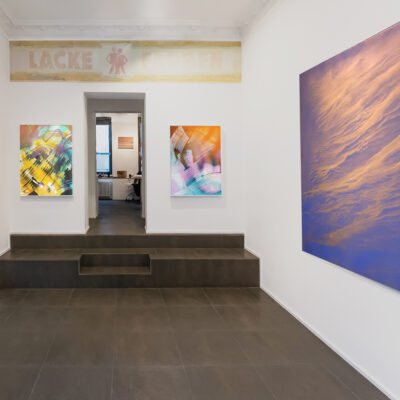
Exhibition Title: It’s a new dawn, it#s a new day
Artists: Julia Benz, Matteo Montani
Location:Luisa Catucci Contemporary, Brunnenstr 170, 10119 Berlin
Curator: Luisa Catucci
Feb 23rd – Apr 7th, 2024
SELECTED EXHIBITIONS
Solo Exhibitions: Die tage des Himmels – Days of Heaven, Luisa Catucci Gallery, Berlin, Germany (2023); New Works, The Elkon Gallery, New York, USA (2023); Nei colori del giorno, Museo Manzù, Ardea (RM), Italy (2022); Costellazione privata, Galleria d’Arte Moderna “G. Carandente”, Spoleto, Italy, curated by Davide Silvioli (2022); BACK AND FORTH. Piero Dorazio / Matteo Montani, Galleria Giovanni Bonelli, Pietrasanta, Italy, curated by Beatrice Audrito (2022); Nel rovescio della palpebra, Otto Gallery, Bologna, Italy (2021); Natura Naturans, with Sue Arrowsmith, Luca Tommasi Arte Contemporanea, Milan, Italy (2020); A lungo andare Unmooring, Valentina Bonomo Gallery, Rome, Italy, text by Laura Cherubini (2019); Elogio della Carta, Museo H.C. Andersen, Rome, Italy (2018); Invitation To A Disaster #15, with Antonio Trimani, Le Stazioni Contemporary Art, Milan, Italy (2018); The Glow and the Glare, Luca Tommasi Arte Contemporanea, Milan, Italy, presented by A. Zanchetta (2017); Recent Paintings, Museo d’Arte Contemporanea, Lissone – Milan, Italy, presented by A. Zanchetta (2017); Unfolding, Una scultura, Reggia di Caserta, Caserta, Italy (2017); Unfolding, Nicola Pedana Arte Contemporanea, Caserta, Italy, curated by Alessandra Troncone (2017); Once Upon A Time Life, Again, The Elkon Gallery, New York, USA, curated by I. del Frate-Rayburn (2016); Racconto Rosso, Galleria L’Attico – Fabio Sargentini, Rome, Italy (2016); Things Behind, Luca Tommasi Arte Contemporanea, Milan, Italy, presented by E. Viola (2015); Matteo Montani and Peter Flaccus, OTTO Gallery, Bologna, Italy (2014); Andarsene, Museo H.C. Andersen, Rome, Italy, curated by G. Simongini (2014); I Luoghi dell’immagine, with Marco Grimaldi, Nuova Galleria Morone, Milan, Italy (2012); Bendini-Montani, Così vicini così lontani, Museo Carichieti, Chieti, Italy, curated by G. Simongini (2012); Ausstellung, Istituto Italiano di Cultura, Wolfsburg, Germany (2011); Ausstellung, Istituto Italiano di Cultura, Köln, Germany (2011); Seelenlandschaft, Museum Am Dom, Würzburg, Germany, curated by D. Sarchioni (2011); Parole sulla montagna, Studio Giangaleazzo Visconti, Milan, Italy (2010); A Cielo aperto, OTTO Gallery, Bologna, Italy (2010); Matteo Montani, Casa Italiana Zerilli-Marimò, New York, USA, curated by I. del Frate (2010); Il Guardiano della soglia, Kalfayan Galleries, Athens, Greece (2010); Discorso, Palazzo Grazioli, Rome, Italy, curated by C. D’Orazio, Reti (2009); Abbassare il cielo agli occhi, Paci Contemporary, Brescia, Italy, curated by M. Cavallarin (2009); Naturaldurante, Galleria Marilena Bonomo, Bari, Italy (2009); Matteo Montani, Museo d’Arte, Ravenna, Italy, curated by M. Tonelli (2008); Il Bacio ed altre strade per le stelle, Galleria Valentina Bonomo, Rome, Italy (2008); Fostèr, Galleria L’Attico – Fabio Sargentini, Rome, Italy (2007); Passerò per via Nicolò dell’Arca, Galleria Marilena Bonomo, Bari, Italy (2005).
Group Exhibitions: The Ubiquity of Elsewhere, Luisa Catucci Contemporary, Berlin, Germany (2026), LifeLine, K11 ART MALL – L3 ART CONNEXION, Guangzhou, China, in collaboration with Interculture, Guangzhou; Moordn Art Fair, Guangzhou; Luisa Catucci Contemporary, Berlin (2026); Abstraction, The Elkon Gallery, New York, USA (2024); Le tentazioni di Apollo, Prac Arte Contemporanea, Ponzano Romano, Italy (2024); Between, Carlo Cinque Gallery, Milan, Italy (2024); It’s a New Dawn, It’s a New Day – Matteo Montani and Julia Benz, Luisa Catucci Gallery, Berlin, Germany (2024); A Collector’s Story, Taviloğlu Collection Exhibition, Istanbul Painting and Sculpture Museum, Istanbul, Turkey (2024); Stazionari altrove: Cecchini – Montani – Schillaci – Tirelli, Otto Gallery, Bologna, Italy (2023); Dodici fantasmagorici, Galleria L’Attico, Rome, Italy (2023); Figures: Yesterday and Today, The Elkon Gallery, New York, USA (2023); Building an Art Bridge between Italy and Zambia, Lusaka National Museum, Lusaka, Zambia, curated by Costantino D’Orazio (2022); Large Formats, The Elkon Gallery, New York, USA (2022); Group Show, Rarity Gallery, Mykonos, Greece (2022); Orizzonti del corpo, Palazzo Magnani, Reggio Emilia, Italy, curated by Marina Dacci (2021); Works on Paper, The Elkon Gallery, New York, USA (2021); Così fan tutti, Opere della collezione Ernesto Esposito, Villa Campolieto, Ercolano, Italy (2021); Time is Out of Joint, Galleria Nazionale d’Arte Moderna e Contemporanea, Rome, Italy, curated by Cristiana Collu (2021); Italian Twist, Fondazione Imago Mundi, Gallerie delle Prigioni, Treviso, Italy (2021); Libertà, Castello di Lajone, Alessandria, Italy, curated by Luca Beatrice (2020); Abstraction: From 1960 to Now, The Elkon Gallery, New York, USA (2020); Apocalypse, Galleria Nicola Pedana, Caserta, Italy (2019); The Quest for Happiness, Italian Art Now, Serlachius Museum, Mänttä, Finland (2019); Contemplating the Spiritual in Contemporary Art, Rosenfeld Porcini Gallery, London, UK (2019); White Views, Italian Cultural Institute, London, UK (2019); Franca Rame 90 anni di Spettacolo, Musalab, Verona, Italy (2019); A misura d’uomo, Luca Tommasi Arte Contemporanea, Milan, Italy (2019); Join the Dots, Salone degli Incanti, Trieste, Italy (2018); Scorribanda, La Galleria Nazionale, Rome, Italy (2018); Small Formats, The Elkon Gallery, New York, USA (2018); Premio Michetti, 69th edition, Francavilla al Mare, Italy, curated by Renato Barilli (2018); Incontri, ex Chiesa dell’Annunziata, Teano, Italy, presented by V. Catricalà (2018); Colore non Colore, Galleria Valentina Bonomo, Rome, Italy (2018); Works on Paper, The Elkon Gallery, New York, USA (2017); Large Formats, The Elkon Gallery, New York, USA (2017); The Art of Humanity, Pratt Institute, The Rubelle and Norman Schafler Gallery, New York, USA (2016); Under One Sky, Dianxi Science and Technology Normal University, Dianxi, China (2016); Abstraction, The Elkon Gallery, New York, USA (2016); La Pelle, issued by Fondaco, Officina, Brussels, Belgium (2016); Unioni Civili, Galleria L’Attico – Fabio Sargentini, Rome, Italy (2016); Anni Zero, The Temple University, Rome, Italy, curated by A. Dambruoso (2016); Praestigium Italia, Fondazione Sandretto Re Rebaudengo, Turin, Italy (2015); In Abstracto, Galleria Alessandro Casciaro, Bolzano, Italy, curated by M. Rossi (2015); C’è chi dipinge…, Galleria L’Attico – Fabio Sargentini, Rome, Italy (2015); Map of the New Art, Fondazione Giorgio Cini, Venice, Italy (2015); Duets, Luca Tommasi Arte Contemporanea, Milan, Italy (2015); Unioni Civili, Galleria L’Attico, Rome, Italy (2015); Non solo fotografia, Paci Contemporary, Brescia, Italy (2014); Biennale d’Arte, Palazzo dei Papi, Viterbo, Italy, curated by G. De Feo and L. Lucibello (2014); Premio Vasto, Vasto, Italy, curated by G. Simongini (2014); Biennale Cina – Italia, 798 Art District, Beijing, China, curated by Mian Bu (2014); Premio Michetti, 64th edition, Francavilla al Mare, Italy (2013); Blue, Kalfayan Galleries, Athens, Greece (2013); Neue Sammlung, Mittelberg, Burg Museum, Germany (2012); Quaterna, Galleria L’Attico – Fabio Sargentini, Rome, Italy (2012); Al principio del vedere, Castel Arquato, Italy, curated by M. Galbiati (2012); Nuova creatività italiana, Officina Italia2, Bologna/Milan, Italy, curated by R. Barilli (2011); Scritture, Galleria Marilena Bonomo, Bari, Italy (2011); Liquid Flags, Sassoferrato, Italy, curated by G. Simongini (2011); Il Santo Momento, Museum Am Dom, Würzburg, Germany, curated by D. Sarchioni (2011); A perdita d’occhio, Galleria L’Attico – Fabio Sargentini, Rome, Italy (2010); Crossroads, Il Frantoio, Capalbio, Italy (2010); Un mosaico per, Tornareccio, Italy, curated by G. Simongini (2010); Puglia Contemporanea: Artisti a Palazzo, Gagliano del Capo, Italy, curated by L. Pratesi (2010); Oltre il trompe l’oeil, Galleria L’Attico – Fabio Sargentini, Rome, Italy (2010); Falsi Astratti, Galleria L’Attico – Fabio Sargentini, Rome, Italy (2009); La testa tra le nuvole, Convento dei Carmelitani Scalzi, Viterbo, Italy, curated by M. Carriero (2009); 1+1, Galleria Marilena Bonomo, Bari, Italy (2009); Clicking the Cosmos, Museo di Arte Contemporanea, Vespolate, Italy (2009); Da qui, Galleria 3)5, Rieti, Italy (2009); Premio Cairo, Triennale di Milano, Milan, Italy (2008); Spore, Atomi, Stelle, Galleria L’Attico – Fabio Sargentini, Rome, Italy (2008); XV Quadriennale d’Arte, Palazzo delle Esposizioni, Rome, Italy, curated by L. Canova, D. Lancioni and C. Spadoni (2008).
Public Collections: Collezione Artefiera, Bologna, Italy; Fondazione La Quadriennale, Rome, Italy; Galleria Nazionale d’Arte Moderna, Rome, Italy; MAR, Ravenna, Italy; Musei Vaticani, Vatican City; Museo Andersen, Rome, Italy; Museo Michetti, Francavilla al Mare, Italy; Museum Am Dom, Würzburg, Germany; Museum Burg, Miltenberg, Germany; Serlachius Museum, Mänttä, Finland; VAF Foundation, Frankfurt am Main, Germany.
Main Private Collections: Collezione Benetton, Treviso, Italy; Collezione Ernesto Esposito, Naples, Italy; Collezione Longo, Cassino, Italy; Collezione UniCredit, Milan, Italy; Four Seasons, Seoul, South Korea; Novartis Corporation, Whippany, New Jersey, USA; Raffles, Katara Towers, Doha, Qatar; Fairmont – Shibaura Tower, Tokyo, Japan.
Prizes: Premio Licini, Ascoli Piceno, Italy: finalist (2022); Winner of PAC 2020, promoted by Direzione Generale Arte Contemporanea and Ministry of Cultural Heritage, Italy (2021); Winner of the 69th edition of Premio Michetti, Italy (2018); Winner of the Special Jury Prize of the Premio Michetti, Italy (2013); Premio Terna 02, Italy: finalist (2009); Premio Cairo, Milan, Italy: finalist (2008); Talent Prize, Rome, Italy: finalist (2008); Premio Lissone, Lissone, Italy: finalist (2007); Winner of the national selection for the Biennale of Young Artists from Europe and the Mediterranean, Sarajevo, Bosnia and Herzegovina (2001); Winner of XL Premio Suzzara, Italy (2000).