
Simone Pellegrini (1972, Ancona, Italy) is an Italian painter who lives and works in Bologna, where he teaches painting at the Academy of Fine Arts and where his studio is located. His career as an artist began in 1996, during his training at the Academy of Fine Arts in Urbino, where he graduated in 2000. Since 2003 he has had more than forty solo exhibitions in Italy and abroad – with recent presentations in New York, Münster and Salzburg. In summer 2023 an anthological exhibition dedicated to him opened in Lugano at MUSEC, the Museo delle Culture.
He has exhibited in Italy, in institutions such as Palazzo Magnani and Collezione Maramotti in Reggio Emilia, Museo delle Trame Mediterranee in Gibellina, Palazzo dei Priori in Volterra, MAC-Museo d’Arte Contemporanea in Lissone, Villa Torlonia in San Mauro Pascoli, Museo di Palazzo Pretorio in Prato, Archaeological Park of Pompeii, Villa d’Este in Tivoli, MAMbo in Bologna, CIAC in Genazzano, Museo della Permanente in Milan, Villa Reale in Monza, Museo della città and FAR-Fabbrica Arte in Rimini, Casa natale di Raffaello in Urbino e Fondazione l’Arca in Teramo, and at the Venice Biennale in collateral events. Abroad, in museums such as Gugging in Vienna, Pablo Picasso in Münster o Stadtgalerie in Kiel, National Gallery of Arts in Tirana, Mact/Cact in Bellinzona and at Messums Wiltshire in Salisbury and in a different private art spaces in London, Paris, Brussels and more.
His artworks belong to international public and private collections, such as Collezione Farnesina, Roma; Der Privatstiftung – Künstler aus Gugging, Vienna; Collection Museo delle Trame Mediterranee, Gibellina; Collection Lissone Prize of MAC – Museo d’Arte Contemporanea, Lissone; Collection Maramotti, Reggio Emilia; Bologna Fiere, permanent collection, Bologna; Art Collection UniCredit, Milano; Collection Gabriele Mazzotta, Milano; Palazzo Forti, Verona; Musei Civici di Monza, Casa degli Umiliati, Monza; Archivio Biennale Disegno, Rimini; Collection Volker Feierabend, Frankfurt am Main; Collection Wolfgang Hanck, Museum Kunstpalast in Düsseldorf.
Simone Pellegrini’s work evokes landscapes, cosmogonies and cartographies that recall ancient, mystical and pagan iconography. His is a work of excavation in the collective and unconscious memory. The technical process seems to respect laws and rituals that he has given himself over the years, a few shades of primary colours, the monotype with matrixes created by the artist, used only once and then destroyed. Each work is unrepeatable, unique.
He has created for the French publishing house Fata Morgana the artist’s book Dans la chambre du silence.
Simone Pellegrini (1972, Ancona, Italy) is an Italian painter who lives and works in Bologna, where he teaches painting at the Academy of Fine Arts and where his studio is located. His career as an artist began in 1996, during his training at the Academy of Fine Arts in Urbino, where he graduated in 2000. Since 2003 he has had more than forty solo exhibitions in Italy and abroad – with recent presentations in New York, Münster and Salzburg. In summer 2023 an anthological exhibition dedicated to him opened in Lugano at MUSEC, the Museo delle Culture.
He has exhibited in Italy, in institutions such as Palazzo Magnani and Collezione Maramotti in Reggio Emilia, Museo delle Trame Mediterranee in Gibellina, Palazzo dei Priori in Volterra, MAC-Museo d’Arte Contemporanea in Lissone, Villa Torlonia in San Mauro Pascoli, Museo di Palazzo Pretorio in Prato, Archaeological Park of Pompeii, Villa d’Este in Tivoli, MAMbo in Bologna, CIAC in Genazzano, Museo della Permanente in Milan, Villa Reale in Monza, Museo della città and FAR-Fabbrica Arte in Rimini, Casa natale di Raffaello in Urbino e Fondazione l’Arca in Teramo, and at the Venice Biennale in collateral events. Abroad, in museums such as Gugging in Vienna, Pablo Picasso in Münster o Stadtgalerie in Kiel, National Gallery of Arts in Tirana, Mact/Cact in Bellinzona and at Messums Wiltshire in Salisbury and in a different private art spaces in London, Paris, Brussels and more.
His artworks belong to international public and private collections, such as Collezione Farnesina, Roma; Der Privatstiftung – Künstler aus Gugging, Vienna; Collection Museo delle Trame Mediterranee, Gibellina; Collection Lissone Prize of MAC – Museo d’Arte Contemporanea, Lissone; Collection Maramotti, Reggio Emilia; Bologna Fiere, permanent collection, Bologna; Art Collection UniCredit, Milano; Collection Gabriele Mazzotta, Milano; Palazzo Forti, Verona; Musei Civici di Monza, Casa degli Umiliati, Monza; Archivio Biennale Disegno, Rimini; Collection Volker Feierabend, Frankfurt am Main; Collection Wolfgang Hanck, Museum Kunstpalast in Düsseldorf.
Simone Pellegrini’s work evokes landscapes, cosmogonies and cartographies that recall ancient, mystical and pagan iconography. His is a work of excavation in the collective and unconscious memory. The technical process seems to respect laws and rituals that he has given himself over the years, a few shades of primary colours, the monotype with matrixes created by the artist, used only once and then destroyed. Each work is unrepeatable, unique.
He has created for the French publishing house Fata Morgana the artist’s book Dans la chambre du silence.
“For me, art is a way of giving a certain continuation to misunderstandings; everything I do not know and everything I misunderstand has to do with the matter of creation. I believe that art is the quintessentially useless thing, and therefore it should not be didactic, it should not be pedagogical, it should not be accompanied by a narrative…” – Simone Pellegrini

Pellegrini’s practice is deeply rooted in manual and artisanal processes. Every element of his works is made by hand, from the preparation of the paper to the creation of the matrices and the final transfer of the image. This slow and physical process is essential to his work: the paper is torn, recomposed, marked, coloured and treated with oil, acquiring its own seams, irregularities and scars.
At first sight, Pellegrini’s works seem to come from a distant time. They might appear as ancestors of the paintings at Lascaux, fragments of a forgotten civilization or traces of an ancient ritual. But looking at them more closely, this first impression begins to shift. The images and symbolic vocabulary seem to reach further than the past, towards an unimaginable and parallel future. The works could appear to have been found in a remote temple in Tibet, yet they are produced in Bologna, in the present. This distance between where the works are made and the time they seem to belong to is central to Pellegrini’s contemporary practice. Their apparent age is therefore not a historical reference but a condition created through material, process and image. His work questions the idea of art history as a linear progression in which one period necessarily follows another. His images move instead across different temporalities, bringing together fragments that seem to belong to the universality of humanity.
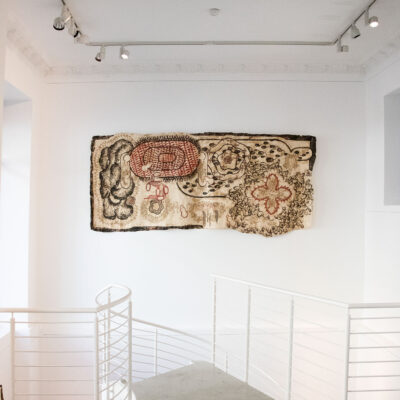
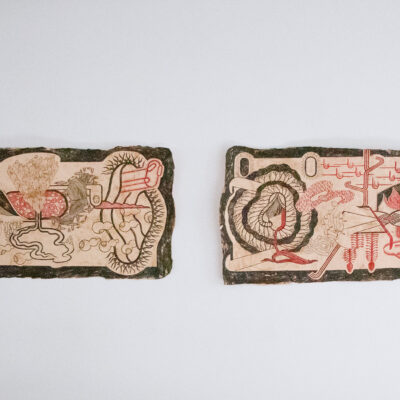
His works are unique monoprints made on a parchment-like paper that the artist constructs himself.
Pellegrini does not draw directly onto the final paper. Instead, he works on small pieces of paper that he calls matrices. These are drawn with charcoal, coloured with red and black pigments and finally treated with linseed oil. The marks are then transferred onto the larger sheet through pressure, using a metal object similar to a stamp. Each matrix is used only once and then discarded, making every impression unique. “They are all negatives, fragments that take on an articulated dimension here; that begin to articulate themselves. These pieces lying on the floor of the studio are the actual originals” Pellegrini explains.
The process produces a collection of fragments that, placed next to one another, form large visionary compositions. Cellular organisms, vegetal forms, fragments of human and animal bodies, architectural structures and objects appear together without following a recognisable narrative. Their relationships are constantly shifting. Familiar forms emerge, but they are never completely defined. The resulting images resemble maps, archaeological fragments or traces of an unknown system of knowledge. They recall mystical iconographies forgery, archaic landscapes, cosmologies, alchemical and esoteric codes, but Pellegrini does not reproduce an existing symbolic language. He creates his own, based on ambiguous sexual forms and signs that resist a single meaning.
“The outline of my works is never attributed to anything specific. Rather, it serves as a target for interpretation, open to anyone who dives into this inner world.”
This openness is fundamental to the work. Pellegrini’s images do not need to be decoded into a fixed narrative. They operate somewhere before language, where a sign can remain a sign without becoming a word or a defined symbol. The viewer is confronted with forms that seem familiar but cannot be fully identified, and is left to establish connections between them.
The result is a visual language that remains deliberately unresolved. It does not explain or instruct, but creates a space in which meaning can emerge, disappear and be reconstructed. Made slowly and entirely through the artist’s own hands in Bologna, these works seem to arrive from somewhere else , simply parallel to our own being.
ARTWORKS HIGHLIGHTS


INSTALLATION VIEWS
Exhibition Title: Chronotopes – Artifacts from Fictional Time-Spaces
Artists: Simone Pellegrini, Aniana Heras, Forlenza
Location: Luisa Catucci Contemporary, Brunnenstr 170, 10119 Berlin
Curator: Luisa Catucci
May 16th – June 14th, 2025




SELECTED EXHIBITIONS
His recent solo exhibitions include Aliosso, Cavin-Morris Gallery, New York, USA (2026); Un moment sans rature, Galerie DYS, Brussels, Belgium (2025); Die Asymptote, Galerie MAM Mario Mauroner Contemporary Art, Salzburg, Austria (2024); An Anarchic Geography, curated by Francesco Paolo Campione and Nora Segreto, MUSEC – Museo delle Culture, Lugano, Switzerland (2023); Turning Point, Cavin-Morris Gallery, New York, USA (2022); Konstellationen, curated by Heiner Hachmeister, Hachmeister Galerie, Münster, Germany (2022); and Escaptura, curated by Arianna Bargellini, Villa Torlonia – Parco Poesia Pascoli, Italy (2022), Passato in giudicato, Museo di Palazzo Pretorio, Prato, Italy (2019).
His recent group exhibitions include Territoires sauvages. Une traversée intérieure, with Galerie DYS, Château de Jau, France (2026); Opera Viva. Storia di una collezione, curated by Stefano Raimondi, MAC – Museo d’Arte Contemporanea, Lissone, Italy (2026); μm Micrometer, Backslash Gallery, Paris, France (2026); The Real Surreal Part III: How the Light Gets In, Cavin-Morris Gallery, New York, USA (2025); Il segno delle origini. Outsider wunderkammer tra storia e sguardi contemporanei, curated by Giorgio Bedoni and Simona Olivieri, Museo Broggi, Melegnano, Italy (2025); Gugging goes millstART: originally_touching!, curated by Nina Katschnig and Irina Katnik, Abbey Millstatt am See, Austria (2025); La forma inquieta. Carlo Zinelli, la linea del sogno, fra Art Brut e scenari contemporanei, curated by Giorgio Bedoni, Galleria Biffi Arte, Piacenza, Italy (2024); The Night, Galerie MAM Mario Mauroner Contemporary Art, Salzburg, Austria (2024); ERRINNERUNGEN BEGEBNISSE VORKOMMNISSE, 30th anniversary exhibition, Galerie Gugging, Vienna, Austria (2024); L’Arte Inquieta. L’urgenza della creazione / Restless Art. The urgency of creation, curated by Giorgio Bedoni, Johann Feilacher and Claudio Spadoni, Fondazione Palazzo Magnani, Reggio Emilia, Italy (2022); Il Numinoso, curated by Giorgio Verzotti, BUILDING, Milan, Italy (2022); Brut Favorites.! Feilacher’s Choice, curated by Johann Feilacher, Museum Gugging, Austria (2022); Otherworldly, curated by Irina Katnik, Galerie Gugging, Vienna, Austria (2021); Lissone Prize 20/21: Breve storia di una nuova prospettiva in pittura, curated by Alberto Zanchetta, MAC – Museo d’Arte Contemporanea di Lissone, Italy (2021); and Phoenix: New Artists and New Works, Cavin-Morris Gallery, New York, USA (2021).
His works are held in the Farnesina Collection of Contemporary Art, Rome; Museo delle Trame Mediterranee, Gibellina; the Lissone Prize Collection of MAC – Museo d’Arte Contemporanea di Lissone; Collection Maramotti, Reggio Emilia; Bologna Fiere Permanent Collection; UniCredit Art Collection, Milan; Collection Gabriele Mazzotta, Milan; Collection Volker Feierabend, Frankfurt; Collection Wolfgang Hanck, Museum Kunstpalast, Düsseldorf; MUSA – Civica Raccolta del Disegno di Salò; Palazzo Forti, Verona; the Collection of the Province of Reggio Emilia; and the Musei Civici di Monza, Casa degli Umiliati, Monza.
His works have also been donated to Fondazione Orestiadi, Gibellina; Do ut do – Associazione Amici della Fondazione Hospice, Bologna; Archivio Biennale Disegno, Rimini; and Der Privatstiftung – Künstler aus Gugging, Vienna.