
Remy Hysbergue (Valenciennes, 1967) lives and works in Paris, France.
After an initial education in applied arts, where he explored animation, textile design, and art history, he continued his studies at the École Nationale Supérieure des Arts Décoratifs (ENSAD) in Paris, where he graduated.
Since the late 1990s, Hysbergue has developed a predominantly non-figurative painting practice exploring the possibilities of painterly language and the relationship between image, perception, and materiality. His work approaches painting as an open field of experimentation, particularly at the threshold between image and material, through the continual transformation of the medium.
Each series marks a new stage in this research, exploring different tools, supports, and methods of applying paint.
Hysbergue has exhibited extensively in France and internationally, including at FRAC Auvergne, FRAC Poitou-Charentes, FRAC Sud in Marseille, the Musée de l’Hospice Saint-Roch in Issoudun, the Musée des Sables d’Olonne, and the Musée des Beaux-Arts de Libourne. His work is held in the collections of several FRACs, the Ohara Museum in Japan, and the Fondation Société Générale in Paris.
Remy Hysbergue (Valenciennes, 1967) lives and works in Paris, France.
After an initial education in applied arts, where he explored animation, textile design, and art history, he continued his studies at the École Nationale Supérieure des Arts Décoratifs (ENSAD) in Paris, where he graduated.
Since the late 1990s, Hysbergue has developed a predominantly non-figurative painting practice exploring the possibilities of painterly language and the relationship between image, perception, and materiality. His work approaches painting as an open field of experimentation, particularly at the threshold between image and material, through the continual transformation of the medium.
Each series marks a new stage in this research, exploring different tools, supports, and methods of applying paint.
Hysbergue has exhibited extensively in France and internationally, including at FRAC Auvergne, FRAC Poitou-Charentes, FRAC Sud in Marseille, the Musée de l’Hospice Saint-Roch in Issoudun, the Musée des Sables d’Olonne, and the Musée des Beaux-Arts de Libourne. His work is held in the collections of several FRACs, the Ohara Museum in Japan, and the Fondation Société Générale in Paris.
“I paint painting” – Remy Hysbergue

Rémy Hysbergue’s painting practice occupies a space of tension between matter and image, gesture and control, painterly tradition and contemporary visual culture. Rather than engaging with representation as an end in itself, Hysbergue takes painting as a subject of investigation. As suggested by his statement, “I paint painting,” his practice focuses on the processes through which an image is constructed, transformed, and perceived.
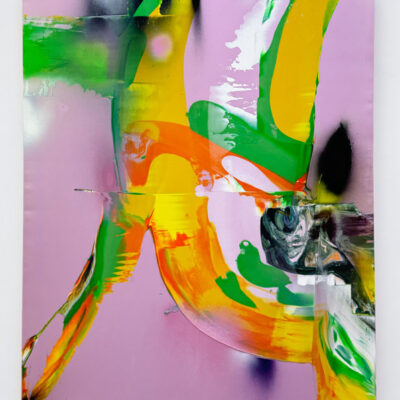
This investigation gives rise to images that remain deliberately unstable. From a distance, Hysbergue’s works can appear precise and resolved; closer inspection reveals layers, interruptions, variations in density, and traces of the painting process. The image consequently shifts from something fixed to a perceptual experience in constant transformation.
Photography, cinema, graphic design, and digital imagery are important points of reference, not as visual repertoires to be reproduced, but as forms to be reconsidered through painting. Hysbergue incorporates qualities associated with contemporary imagery—multiplication, layering, manipulation, and transformation—while returning them to the physical and singular dimension of the painted surface. His work thus reflects on the tension between the immateriality of the image and the material presence of painting.
The support plays an active role in this process. Materials such as velvet, with their particular tactile and luminous qualities, affect the perception of colour and surface, while more recent works on Komacel—a lightweight PVC foam with a smooth, matte, unreflective surface—create a contrasting ground for iridescent colours that shift according to light and the viewer’s position. The support is therefore not neutral, but integral to the construction and perception of the image.
Colour is central to Hysbergue’s practice, not as a decorative or purely compositional element, but as a means of altering the perception of space and light. Through variations in intensity, layering, and chromatic contrast, colour generates depths that do not physically belong to the surface but emerge through the viewer’s perception. Intense hues may gradually dissolve, while darker fields are crossed by luminous interventions created through airbrushing. Light is consequently not represented but produced through the behaviour of colour and material.
Hysbergue’s practice moves freely between monochromatic works, broad chromatic fields, and compositions in which contrasting hues form complex structures. Gesture remains equally important: a brushstroke, glaze, or trace of airbrushing can suggest light, distance, movement, or relief. Painting becomes a space in which colour does not describe space, but generates it.
Since the 1990s, Hysbergue has worked in series, considering each body of work complete once he has exhausted the possibilities of its chosen protocol, which he may then abandon or rework. Successive series—including Cordialement, Vides faits, Abracadabra, Laps, Bluff, Esbrouffes, Pneuma, Distractions, Fiction, and Réversible—are conceived as systematic experiments testing different possibilities of painting. Across them, he explores colour, covering and unveiling, the occupation of the picture surface, and the potential of different materials.
His method often begins with a simple protocol that is allowed to generate unforeseen results. In some works, a network of adhesive tape is applied to the support before paint is spread across it with a spatula, producing distinct zones and interruptions. These procedures combine a degree of control with the accidents and pictorial slips of the gesture, allowing the process itself to become a source of new images.
Hysbergue’s painting ultimately remains suspended between appearance and erasure, transparency and opacity, order and accident. The image is never presented as a definitive reality, but as something continuously constructed through the encounter between colour, material, light, gesture, and the viewer’s gaze.
ARTWORKS HIGHLIGHTS


INSTALLATION VIEWS
Exhibition Title: The Wisdom Of Peacock
Artists: Wolfgang Flad & Rémy Hysbergue
Location: Luisa Catucci Contemporary, Brunnenstr 170, 10119 Berlin
Curator: Luisa Catucci, Jaeger Art
March 14th – May 14th, 2025


SELECTED EXHIBITIONS
His recent solo exhibitions include Truculences, Galerie Richard, Paris, France (2024); Faire la lumière, Galerie Valérie Eymeric, Lyon, France (2023); Élégants Velours, Haus der Kunst St. Josef, Basel, Switzerland (2023); Sidérales, Galerie Richard, Paris, France (2023–2022); Tout Schuss, Galerie Richard, Paris, France (2022); Velours, Galerie Richard, Paris, France (2021); Sublimations, Galerie Jean Brolly, Paris, France (2016); Grands Dessins et Merveilles, La Galerie, Lyon, France (2015); Auf Papier, Bourouina Gallery, Berlin, Germany (2014); Points du jour, Galerie Jean Brolly, Paris, France (2012); D’ici on pourrait croire que la vue est imprenable, FRAC Poitou-Charentes, Angoulême, France (2009); Rémy Hysbergue, FRAC Auvergne, Clermont-Ferrand, France (2009); Rémy Hysbergue, Nancy Hoffman Gallery, New York, USA (2004); Rémy Hysbergue, Nancy Hoffman Gallery, New York, USA (2003); Rémy Hysbergue, FRAC Auvergne, Clermont-Ferrand, France (2001).
His recent group exhibitions include Ubiquity Of Elsewhere, Luisa Catucci Contemporary, Berlin, Germany (2026); Made in France, Galerie Richard, Paris, France (2025); The Winsdom Of Peacock, Luisa Catucci Contemporary, Berlin, Germany (2025); Art Miami, Galerie Richard, Miami, USA (2024); Catharsis, CAI Gallery, Harelbeke, Belgium (2023); Art Paris, Galerie Richard, Paris, France (2023); Peinture : Obsolescence Déprogrammée – Licences Libres, Musée de l’Hospice Saint-Roch, Issoudun, France (2022); Peinture : Obsolescence Déprogrammée, Musée de l’Abbaye Sainte-Croix et Musée d’Art Moderne et Contemporain des Sables d’Olonne, France (2021); Vitraux d’artistes, Abbaye Royale de Fontevraud, France (2020); News of the Fake, Orangerie du Château de Sucy-en-Brie, France (2018); Disparitions réciproques, FRAC Poitou-Charentes, Angoulême, France (2014); Ulysses : Les douceurs du péché, FRAC PACA, Marseille, France (2013).
His works are held in public collections such as Fonds National d’Art Contemporain (FNAC), Paris, France; Fonds Municipal d’Art Contemporain (FMAC), Paris, France; FRAC Auvergne, Clermont-Ferrand, France; FRAC Poitou-Charentes, Angoulême, France; Musée des Beaux-Arts d’Angers, France; Ohara Museum of Art, Kurashiki, Japan.
His works are held in private collections such as Société Générale Collection, Paris, France.