
Markus Keibel (born 1964 in Stuttgart) lives and works in Berlin, Germany.
Before dedicating himself entirely to art, Keibel pursued an unconventional career as a professional skateboarder and snowboarder, working in the field from 1984 to 1988. From 1988 to 1993, he studied at the Merz Akademie in Stuttgart, where he received a diploma in Communication Design. Among his lecturers were Julio Rondo and H. von Wedel. During the 1990s, he continued his studies in philosophy at the University of Tübingen.
Alongside his artistic practice, Keibel has worked in education and within the cultural field. He was an assistant to the artist Thomas Locher and taught at the Merz Akademie in Stuttgart. In 2000, he began collaborating with the art collective Microbo. From 2004 to 2005, he taught art and art history at the Michael Bauer Schule in Stuttgart. In 2011, he worked at the Charité in Berlin with young people suffering from anorexia, and in 2015 he taught at the Faculty of Architecture at the University of Düsseldorf.
In 2002, Keibel was awarded a grant by the Kunststiftung Baden-Württemberg.
Since the 1990s, Keibel has exhibited extensively in European and international cities, including Stuttgart, Berlin, Mannheim, Lucerne, Milan, Venice, Istanbul, and New York. His exhibitions have been presented at venues including Galerie Urs Meile in Lucerne, Arch 402 Gallery in London, and the Goethe-Institut in Izmir.
Markus Keibel (born 1964 in Stuttgart) lives and works in Berlin, Germany.
Before dedicating himself entirely to art, Keibel pursued an unconventional career as a professional skateboarder and snowboarder, working in the field from 1984 to 1988. From 1988 to 1993, he studied at the Merz Akademie in Stuttgart, where he received a diploma in Communication Design. Among his lecturers were Julio Rondo and H. von Wedel. During the 1990s, he continued his studies in philosophy at the University of Tübingen.
Alongside his artistic practice, Keibel has worked in education and within the cultural field. He was an assistant to the artist Thomas Locher and taught at the Merz Akademie in Stuttgart. In 2000, he began collaborating with the art collective Microbo. From 2004 to 2005, he taught art and art history at the Michael Bauer Schule in Stuttgart. In 2011, he worked at the Charité in Berlin with young people suffering from anorexia, and in 2015 he taught at the Faculty of Architecture at the University of Düsseldorf.
In 2002, Keibel was awarded a grant by the Kunststiftung Baden-Württemberg.
Since the 1990s, Keibel has exhibited extensively in European and international cities, including Stuttgart, Berlin, Mannheim, Lucerne, Milan, Venice, Istanbul, and New York. His exhibitions have been presented at venues including Galerie Urs Meile in Lucerne, Arch 402 Gallery in London, and the Goethe-Institut in Izmir.
“And perhaps participation begins in the smallest of moments — when one person chooses not to stand outside the circle of becoming”. – Markus Keibel

Markus Keibel’s work focuses on the transformation of matter, participation, and the conditions of perception. Rather than offering definitive answers, he creates open-ended situations in which the audience, time, and environment become part of the artistic process. At the core of his practice lies a reflection on the relationship between the individual and society, with particular attention to freedom, responsibility, and independent thought. His background in philosophy informs a body of work that seeks less to provide answers than to create conditions for questioning. In this sense, his works often take the form of questions, such as Frei? Wozu? — Free? What for?
This political and philosophical dimension becomes particularly evident in UltraUtopia and UltraUtopia 2, where references to the Enlightenment, Kant, the Universal Declaration of Human Rights, humanism, and modernist architecture are critically recontextualised. Rather than treating these traditions as fixed bodies of knowledge, Keibel places them within situations in which their promises, contradictions, and historical conditions can be reconsidered.
A central element is the book, understood not only as a container of knowledge but also as a material and political object. Keibel’s use of texts associated with the Enlightenment and humanism opens the work toward the longer history of books that have been censored, prohibited, suppressed, or destroyed. The history of the book is also a history of power: of deciding who may speak, what may be read, which ideas may circulate, and which forms of knowledge are considered legitimate. This extends across the histories of religion, philosophy, science, and cultural authority, including Christianity’s long and contested relationship with questions of orthodoxy, heresy, interpretation, and access to knowledge.
In these works, Keibel burns books and texts including Kant’s What Is Enlightenment?, Diderot’s Encyclopédie, and the Universal Declaration of Human Rights, incorporating their ashes into paintings and installations. Fire becomes a means of transforming cultural knowledge into physical matter. The resulting ash is not simply a residue of destruction but a new medium through which ideas, histories, and political values are reconfigured. Burning can signify censorship and destruction, but also preservation, transformation, and metamorphosis. What is no longer readable as a book remains present as material: language becomes matter, knowledge becomes residue, and historical memory becomes physical trace.
In UltraUtopia 2, this process extends into physical space, where fragile glass plates are arranged across the floor and may break under the visitor’s weight. The viewer is no longer a detached observer: moving through the installation, stepping onto the glass, hearing it break, or choosing where to place one’s body becomes part of the work. Unlike the ashes, produced through a deliberate act of destruction, the breaking of the glass may be caused by the visitor. Participation therefore acquires material consequences, turning responsibility from a philosophical concept into an embodied experience.
Keibel’s installations consequently destabilise the distinction between observing and acting. To enter the work is already to assume a position within it. This relationship between individual agency and collective structures extends throughout his practice, where meaning emerges through encounter rather than predetermined interpretation. Moving, observing, reading, touching, altering, or simply taking a position can become part of the artwork.
Matter itself — pigment, glass, ash, stone, bitumen, tar, oil, and acrylic paint — acquires a temporal and conceptual dimension. In Keibel’s painting, the image emerges through a negotiation between gesture, material, and structure, often resisting a clear distinction between abstraction and representation. Forms, traces, and fields of colour oscillate between the recognisable and the indeterminate, while the physical act of making remains visible within the finished work.
Colour functions not simply as representation but as an active spatial and emotional element. Layers, stains, marks, and shifts in density reveal the process of painting, while his experimental approach to supports — including delicate materials such as silk — introduces further relationships between pigment, surface, light, and fragility. Rather than treating the canvas as a neutral ground, Keibel allows the behaviour of each material to become integral to the work. The resulting surfaces reveal both an image and the physical conditions through which it has emerged.
Across Keibel’s practice, transformation therefore operates on material, conceptual, and social levels. Books become ash, ash becomes pigment, pigment becomes image, and the image becomes a situation in which the viewer must take a position. Fragile materials and acts of destruction raise questions about perception, preservation, memory, authority, and the transmission of knowledge. Rather than telling the viewer what to think, Keibel constructs situations in which thinking itself becomes part of the work. His practice asks what freedom might mean not simply as the absence of constraint, but as the capacity to think independently, assume responsibility, and recognise one’s participation in a shared process.
Perhaps participation begins in the smallest of moments — when one person chooses not to stand outside the circle of becoming.
ARTWORKS HIGHLIGHTS


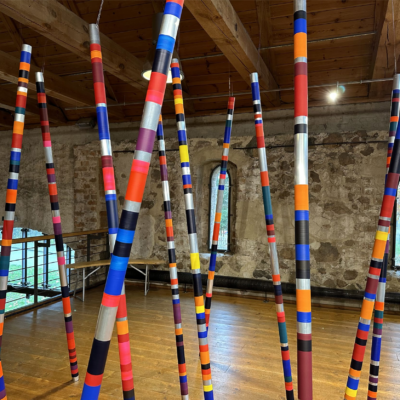

INSTALLATION VIEWS
Exhibition Title: The Ubiquity of Elsewhere
Artists: José Angelino, Alessia Armeni, Barbara Boekelman, Matteo Montani, Remy Hysbergue, Antti Pussinen, Markus Keibel, Saverio Tonoli, Antonello Viola
Location: Luisa Catucci Contemporary, Brunnenstr 170, 10119 Berlin
Curator: Luisa Catucci and Melania Rossi
Aug 29th – Oct 10th, 2026


SELECTED EXHIBTIONS
His recent solo exhibitions include Patriarchy fades the future rises Luisa Catucci Gallery, Berlin, Germany (2026); Traité sur la tolérance, Galerie Max Weber Six Friedrich, Munich, Germany (2019); Molotow, Epicentro Art, Berlin, Germany (2018); Declaration of Independence, Corner, Berlin, Germany (2017); UltraUtopia, Anna Jill Lüpertz Gallery, Berlin, Germany, and UltraUtopia 2, Space for Artistic Research, Düsseldorf, Germany (2016); Brute Force, AJLArt, Berlin, Germany (2014); Zehn Fragen zur Freiheit, Schloss Genshagen, Genshagen, Germany (2013); Mind on Fire, Artary Gallery, Stuttgart, Germany (2012); A&O, AJLArt @ U37, Berlin, Germany, and Inside Complexity, Arch 402 Gallery, London, UK (2011); Freiheit, Özgürlük, Goethe-Institut, Izmir, Turkey (2010); Das Unmögliche Denken, Artary, Stuttgart, Germany (2009); Magnus Müller, Berlin, Germany (2008); Das sichtbare und das unsichtbare Herz, Galerie Bernhard Knaus, Frankfurt, Germany (2007); Plans for another world, Galerie Reinhard Hauff, Stuttgart, Germany (2003); Deine Freiheit…, Kunststiftung Stuttgart, Germany (2002); Czarnikauer 6, Berlin, Germany (2001); Wir/sie, Peripherie Tübingen, Germany (2000); In between, Galerie Reinhard Hauff, Stuttgart, Germany (1999); See, Galerie Urs Meile, Lucerne, Switzerland, and Ich, wir / wir ich, St.-Agnes-Kirche, Cologne, Germany (1998); Zirkulation, Galerie Reinhard Hauff, Stuttgart, Germany (1997); Zeit, Oberwelt, Stuttgart, Germany (1996); Stazione Venezia, Venice, Italy (1995); Galerie Achim Kubinski, Stuttgart, Germany (1994); and Rundgang, Künstlerhaus Stuttgart, Germany (1993).
His group exhibitions include The Ubiquity of Elsewhere, Luisa Catucci Contemporary, Berlin, Germany (2026); BROUHAHA II, Max Weber Six Friedrich, Munich, Germany (2023); You Only Live Twice, Max Weber Six Friedrich, Munich, Germany (2022); Panik…oder so, Max Weber Six Friedrich, Munich, Germany (2021); Works on Paper 4, Max Weber Six Friedrich, Munich, Germany (2020); SMALL – an exploration of miniature, Sexauer Gallery, Berlin, Germany (2017); Rohkunstbau XX. Revolution, Schloss Roskow, Roskow, Germany (2014); sublim.kursiv, Epicentro Art, Berlin, Germany, and 18 hours a day, Kreuzbergpavillon, Kassel, Germany (2012); Paperwork, AJLart @ U37 – Raum für Kunst, Berlin, Germany, and Crosswords, Galerie Jordan/Seydoux, Berlin, Germany (2011); Inkonstruktion V, Art Biesenthal, Biesenthal, Germany (2010); Kunstverein Ludwigshafen, Germany, Zwischenstand, Württembergischer Kunstverein, Stuttgart, Germany, and Fernbeziehung Stuttgart-Berlin, Kunststiftung Baden-Württemberg, Stuttgart, Germany (2008); Statement, with Harald Hermann, Galerie Bernhard Knaus, Frankfurt am Main, Germany, and Space Control, Assab One, Milan, Italy (2007); Jahresgaben, Kunstverein Arnsberg, Germany, Kunstclub Hamburg, Hamburg, Germany, and Freiheit und Gnade, with Harald Hermann, Galerie Bernhard Knaus, Mannheim, Germany (2006); Vom Ansich zum Fürsich zum Wirsich, with Harald Hermann, Galerie Müllerdechiara, Berlin, Germany (2005); La gaia assenza, Berchidda, Sardinia, Italy (2002); and Fototriennale, Künstlerhaus, Hamburg, Germany (1999).
His works are held in private collections including Sammlung Lützow, Berlin, Germany, and the Classik Hotel Collection at Alexander Plaza, Berlin, Germany.